

Right now, as you read this, Earth is in the middle of an ice age. Not in the past. Not a metaphor. Right now. Most people picture an ice age as a frozen world of mammoths and advancing glaciers. That image is partly right, but we are currently in a warmer pause within an ice age and not outside of it. The story of how we got here begins with two continental plates (Eurasian plate and Indian plate) crashing into each other in slow motion.
A History of Frozen Earth
If you have been following this series, you already know Earth’s first major ice age: the Huronian glaciation, triggered 2.4 billion years ago when cyanobacteria flooded the atmosphere with oxygen and dismantled the powerful greenhouse gas methane. Over its long life (nearly 4.6 billion years), Earth has swung in and out of five or six major ice ages. Around 720 million years ago, glaciers crept all the way to the equator in what scientists call Snowball Earth. Each ice age had its own trigger, but shared the same logic: something stripped enough CO₂ from the atmosphere to weaken the greenhouse effect and let ice spread. The current Quaternary glaciation, that has been active since 2.58 million years ago follows that same pattern. Its trigger involves the tallest ‘land’ mountains on Earth.
Two Continents Collide
If you remember the plate tectonics post, the Indian plate was not always where it is today. About 80 million years ago, India sat thousands of kilometers south of Asia, drifting northward at around 15 centimeters a year. Around 50 million years ago, it slowly slammed into the Eurasian plate, slightly pushing it ever since. This slow, but persistent pushing over millions of years led to the formation of the ever-growing mighty Himalayas.
![The Himalayas [This Dynamic Earth, USGS]](https://substackcdn.com/image/fetch/$s_!imjz!,f_auto,q_auto:good,fl_progressive:steep/https%3A%2F%2Fsubstack-post-media.s3.amazonaws.com%2Fpublic%2Fimages%2Fbe16c091-049b-4d90-8b8f-1425ccbdcaae_470x851.jpeg "The Himalayas [This Dynamic Earth, USGS]")
Think of two slow cars colliding head-on where the hoods buckle and crumple upward. The Himalayas and the Tibetan Plateau are that buckle, and the collision is still ongoing as the mountains grow about 5 millimeters every year even now. As the new mountains rose, they exposed enormous amounts of fresh silicate rock to the atmosphere, extremely large area of fresh rock that had never seen rain or open air. And fresh rock, it turns out, is extremely hungry for CO₂.
Mountains That Breathe In CO₂
When rainwater falls through the atmosphere, it absorbs CO₂ and becomes a weak carbonic acid:
CO₂ + H₂O → H₂CO₃
This mildly acidic rain flows over freshly exposed Himalayan rock, dissolving it chemically. For a common silicate mineral like calcium silicate:
CaSiO₃ + 2CO₂ + H₂O → Ca²⁺ + 2HCO₃⁻ + SiO₂
The calcium and bicarbonate ions are carried by rivers like the Ganga, the Brahmaputra, and the Indus that originate in the Himalayas and travel to the seas, where marine organisms use them to build shells. When those organisms die and sink, the carbon gets buried in seafloor rocks. This way, the CO₂ that was floating in the atmosphere is now locked in stone.
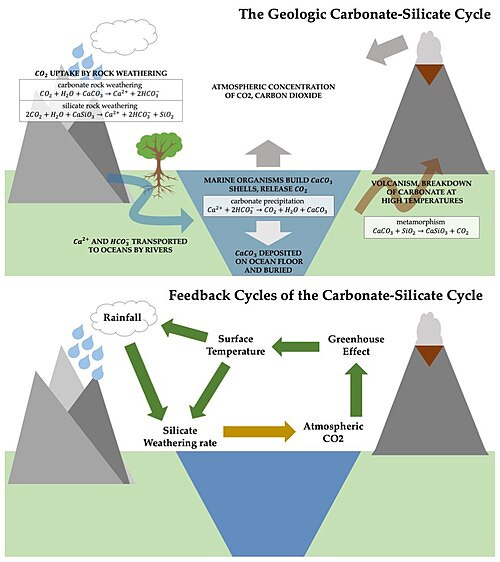
Simply put: the Himalayas acted as a planet-scale CO₂ vacuum and the more they eroded, the faster the engine ran.
This process is called silicate weathering. It operates quietly in the background across all landscapes, but the Himalayas, by exposing an enormous amount of fresh rock, accelerated it far beyond its usual rate.
The Cooling Cascade
Around 50 million years ago, before the Himalayas were formed, the Earth was dramatically warmer than today with CO₂ levels hovered near 1,500–2,000 parts per million (400-500 ppm now) and there were no permanent ice sheets anywhere. All the water that is currently trapped as ice at the poles today was in liquid form back then. Sea levels were roughly 70 meters higher than today. Large cities like London, Mumbai, and New York now would have been open ocean under such sea levels.
As Himalayan weathering steadily drew CO₂ out of the atmosphere over millions of years, the greenhouse effect weakened. It is like slowly turning down a heater on a cold winter night. Temperatures fell, ice sheets grew, and sea levels dropped. By 2.58 million years ago, ice sheets had spread over North America and Europe, which marked the formal start of the Quaternary glaciation.
Being in an ice age simply means permanent ice sheets exist somewhere on Earth. Within one, the climate swings between colder glacial periods and warmer interglacial periods. We are currently in one of those warmer windows called the Holocene, which began around 11,700 years ago. The 800,000-year ice core record from Antarctica’s 3.2 km deep ice core captures exactly these rhythmic swings (how the gases in the atmosphere changed composition in the glacial and interglacial periods).
One raindrop dissolving one grain of silicate rock at a time, carried by rivers to the sea and ended up buried in ocean floors as remains of organisms. That is how the Himalayas slowly tipped Earth into an ice age over tens of millions of years.
We are now doing the reverse in centuries. Burning fossil fuels is returning CO₂ that took millions of years to lock away. The gas the Himalayas slowly removed, we are restoring at speed. The air has memory. And right now, it is remembering everything we are putting back into it.
How was today’s post?
If you liked it, please hit the Like button at the bottom and share it with a friend. Hit the ‘send message’ button if you want to share feedback. Also, please Subscribe to AlterEarth if you haven’t already. Have a great day!
Here are the references that I used for figures and guidance while writing this piece.
References:
Raymo, M. E., & Ruddiman, W. F. (1992). Tectonic forcing of late Cenozoic climate. Nature, 359, 117–122. https://doi.org/10.1038/359117a0
Zachos, J., et al. (2001). Trends, Rhythms, and Aberrations in Global Climate 65 Ma to Present. Science, 292(5517), 686–693. https://doi.org/10.1126/science.1059412
Hoffman, P. F., et al. (2017). Snowball Earth climate dynamics and Cryogenian geology-geobiology. Science Advances, 3(11), e1600983. https://doi.org/10.1126/sciadv.1600983
https://tos.org/oceanography/article/ancient-sea-level-as-key-to-the-future
https://science.nasa.gov/earth/earth-observatory/the-carbon-cycle/
Fabulous piece. Thanks. As a geochemist, it was a pleasure to read.
I've been writing on "what now" instead of our paleoclimatology. This post is a good place to begin if you're interested in some thoughts on moving forward... https://www.co2mmit.org/p/the-six-disciplines-of-a-climate