

Oxygen breathes life into majority of lifeforms on Earth today. It makes up about 21% of the entire atmosphere. But, several billion years ago, the Earth had little to no Oxygen in the air (mainly Carbon dioxide and Methane) and microscopic life thrived all around the planet without it. While these microbes were heating up the Earth by emitting Methane, evolution had different plans for them. If we took a Time Machine and went back to that period, we wouldn’t see any animals or trees as all life was microscopic!
As the Earth was very warm due to a strong greenhouse effect, somewhere in the shallow freshwater or terrestrial environments around the equator, tiny green microbes called cyanobacteria first started to appear ~3.5–2.7 billion years ago (possibly earlier). They used sunlight to split water molecules, releasing Oxygen as waste while converting CO₂ into sugars. In a fascinating twist of fate, the descendants of these very microbes live inside the leaves of today's trees and plants, powering them as parts of chloroplasts (where photosynthesis occurs)!
6CO₂ + 6H₂O → C6H12O6+ 6O₂
For millions of years after they first appeared, these cyanobacteria were reproducing and filling up the waters with Oxygen! When you keep adding water to a filled glass, it eventually spills out. The same thing happens when you keep adding gases to liquids. Once the liquid cannot contain more of the gas, it leaks into the atmosphere (called supersaturation).

Once Oxygen started to enter the atmosphere, growth in cyanobacteria population (that ate away the CO₂) consistently increased the Oxygen percentage in the air. Methane was also a good contributor in keeping the Earth warm when the Sun was Faint. This new Oxygen in the air started reacting with Methane to form Carbon dioxide, which is a much weaker greenhouse gas than Methane.
CH₄ + 2O₂ → CO₂ + 2H₂O
Furthermore, rainfall assisted in bringing atmospheric CO₂ to oceans and rocks on the surface, for it to react with silicate minerals in the rocks and get trapped in them, in a process known as silicate weathering. This has been a very important driver in the Carbon cycle that traps atmospheric CO₂ in rocks (more in a future post).
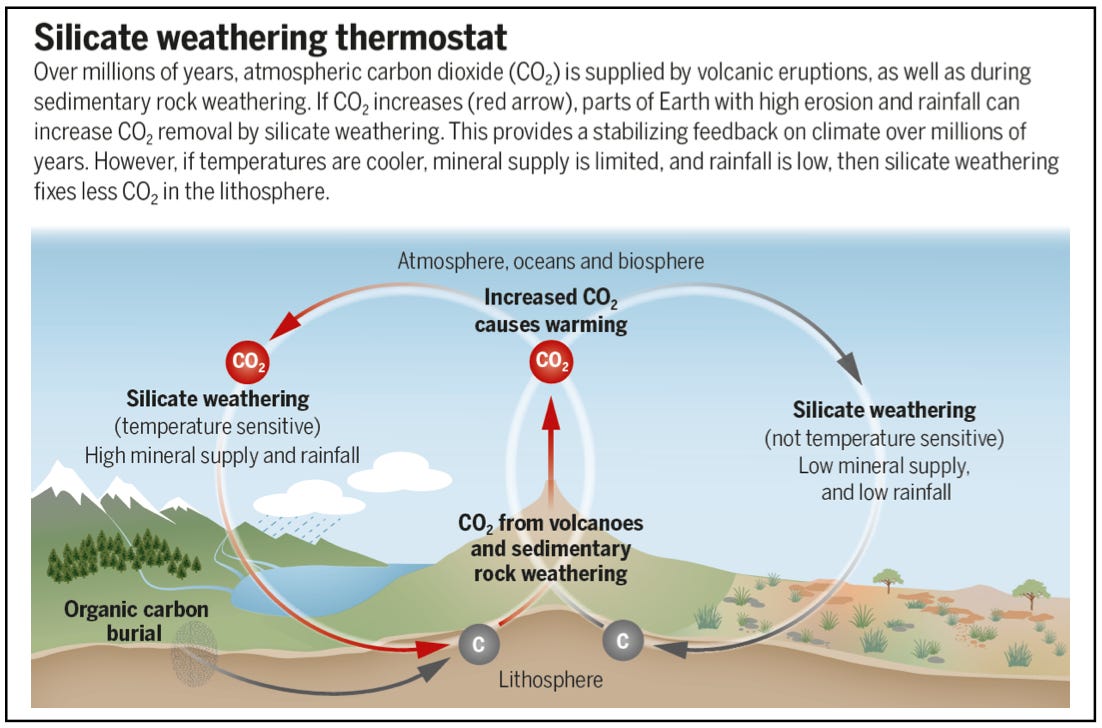
A combination of all the above processes happening together started to disrupt or remove the ‘heaters of the Early Earth (Methane and Carbon dioxide)’ from the atmosphere as Oxygen percentage increased. When we turn off the heater (heat source) on a cold winter night, it does not take long for the cold to creep into the house. This insane coup by Oxygen for place in our atmosphere is referred to as ‘The Great Oxidation Event (GOE)’ and it triggered the cooling of the Earth and led to one of the Earth’s earliest and longest ice ages (Huronian glaciation-nearly 300 million years)!!
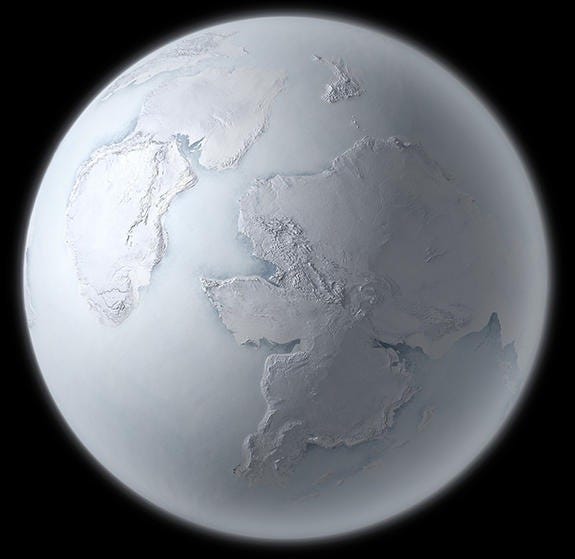
A cumulative effect of the drastic reduction in Methane and Carbon dioxide in the atmosphere and the rapid cooling (in geologic time scale is millions of years) of the Earth that followed it led to the destruction of majority of thriving oxygen-averse life on Earth. In other words, Oxygen almost poisoned most of the life on Earth.
When more than 75% of life on Earth dies in a particular span of time, we call it a ‘Mass extinction event’. There were multiple global mass extinction events in the history of the Earth, but this (GOE) is not included in the five major ones as there are no bodies or fossil evidence to prove the magnitude of microscopic lives lost. If there is no proof of bodily remains from a period, does it mean there was no life or death?
Writing this post reminded me of an excerpt from a comic named Absolute Zero, written by director Christopher Nolan as a spin-off from Interstellar. A good friend and I were admiring it a decade ago. It reads as:
If darkness is only the absence of light…
If cold is only the absence of heat…
If silence is just the absence of sound…
If death is simply the absence of life, then is good the absence of evil, or evil the absence of good?
But, out of this frozen silence, rose an invisible savior. The oxygen overdose on Earth also led to the formation of the Ozone layer when it reacted with solar radiation in the atmosphere. Today, we understand how important the Ozone layer has been throughout its history by saving trillions of life forms from harmful radiation for billions of years. With the protection of the Ozone layer and easy availability of Oxygen, evolution pushed life towards ‘aerobic’ respiration or breathing Oxygen that eventually led to us!
How was today’s post?
If you liked it, please hit the Like button at the bottom and share it with a friend. Hit the ‘send message’ button if you want to share feedback. Also, please Subscribe to AlterEarth if you haven’t already. Have a great day!
Here are the references that I used for figures and guidance while writing this piece.
References:
https://www.imperial.ac.uk/news/171487/imperial-scientist-explains-oxygen-triggered-earths/#:~:text=The%20Great%20Oxidation%20Event%2C%20GOE,evolution%20of%20oxygen%2Dbased%20life.
https://ora.ox.ac.uk/objects/uuid:51bceb86-2983-497d-a986-67657c01e975/files/sww72bc81t
Sato N. Are Cyanobacteria an Ancestor of Chloroplasts or Just One of the Gene Donors for Plants and Algae? Genes (Basel). 2021 May 27;12(6):823. doi: 10.3390/genes12060823. https://pmc.ncbi.nlm.nih.gov/articles/PMC8227023/#abstract1.
https://www.monash.edu/student-academic-success/biology/photosynthesis/the-process-of-photosynthesis#:~:text=PhotosynthesisThe%20process%20by%20which,oxygen%2C%20supporting%20life%20on%20Earth.
Bekker, A. (2011). Huronian Glaciation. In: Gargaud, M., et al. Encyclopedia of Astrobiology. Springer, Berlin, Heidelberg. https://doi.org/10.1007/978-3-642-11274-4_742. https://link.springer.com/rwe/10.1007/978-3-642-11274-4_742#citeas.
https://news.cnrs.fr/articles/when-earth-was-a-snowball
M.R. Warke, T. Di Rocco, A.L. Zerkle, A. Lepland, A.R. Prave, A.P. Martin, Y. Ueno, D.J. Condon, & M.W. Claire, The Great Oxidation Event preceded a Paleoproterozoic “snowball Earth”, Proc. Natl. Acad. Sci. U.S.A. 117 (24) 13314-13320, https://doi.org/10.1073/pnas.2003090117 (2020). https://www.pnas.org/doi/10.1073/pnas.2003090117.
Olejarz, J., Iwasa, Y., Knoll, A.H. et al. The Great Oxygenation Event as a consequence of ecological dynamics modulated by planetary change. Nat Commun 12, 3985 (2021). https://doi.org/10.1038/s41467-021-23286-7. https://www.nature.com/articles/s41467-021-23286-7.
https://asm.org/articles/2022/february/the-great-oxidation-event-how-cyanobacteria-change
https://interstellarfilm.fandom.com/wiki/Absolute_Zero_(comic)
https://slate.com/technology/2014/07/the-great-oxygenation-event-the-earths-first-mass-extinction.html
https://www.sciencedirect.com/science/article/pii/S2772883822000152.
Snowball Earth is awesome.