

The very thick and invisible blanket of air surrounding our planet that is pouring life into almost all of the visible life (yes, there are trillions of tiny organisms that are around you and me all the time) around us today did not come right out of the box when the Earth was first formed. Welcome to the first post in the Air series of AlterEarth.
Just like many scientific hypotheses that cannot be solidly proven, there are multiple theories behind the origin of the atmosphere (the thick layer of gases hugging the Earth). One of the theories states that the atmosphere came from inside the Earth through millions of years of volcanic activity that brought gases from inside the Earth outside the surface- volcanic outgassing. The other theory states that the atmosphere (also water) was brought to the Earth by meteors and asteroids over millions of years. Most scientists believe that it wasn’t just one or the other, but a chaotic mixture of both processes!
On a lighter note, volcanic outgassing can be imagined as a very prolonged ‘burp’ of the Earth as it gave out the early atmosphere.
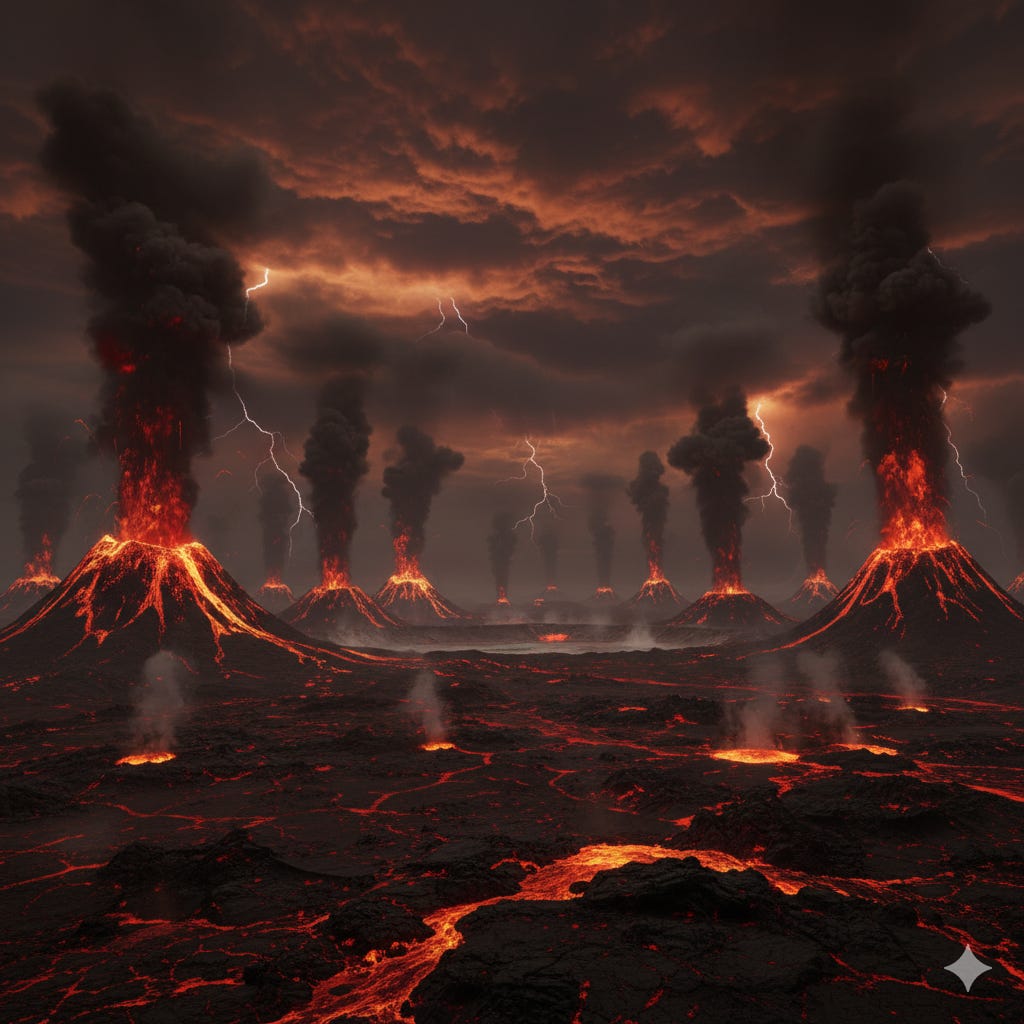
The Early atmosphere did not have any free oxygen, but was mainly made of:
Water vapor (H₂O)
Nitrogen (N₂)
Carbon Dioxide (CO₂)
traces of Sulphur dioxide (SO₂), carbon monoxide (CO), methane (CH₄) and ammonia (NH₃).
As this early atmosphere was being formed, the surface temperature of the Earth was reducing (as the land started to solidify) and this cooling allowed the precipitation of water vapor from the atmosphere to form our oceans.
The Faint Young Sun Paradox
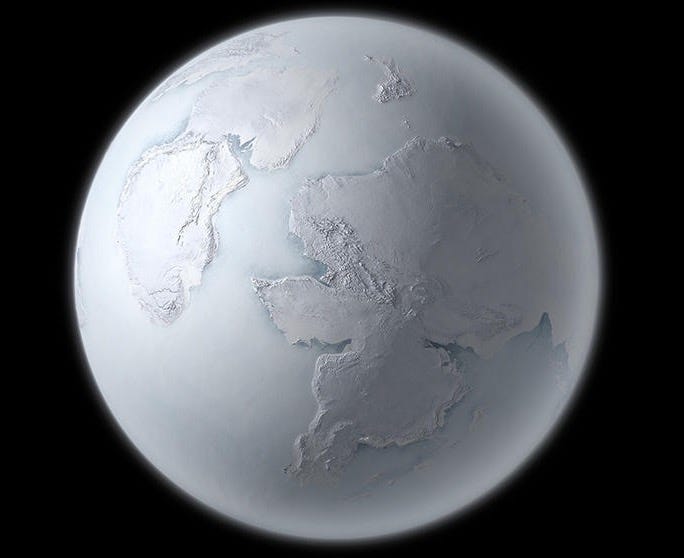
From nearly 4 - 2.5 billion years ago, our Sun was not as bright and hot as it is now. It was in fact 20-30% fainter. During this time, the Earth should have been a frozen ball of ice with surface temperatures dropping drastically. But, water on Earth was in its liquid form throughout this period (geologic evidence) and scientists call this the ‘Faint Young Sun Paradox’.
Greenhouse effect kept the Earth warm when the Sun was ‘Faint’ or ‘Cooler’
In today’s metrics, as the solar radiation travels from the Sun to the Earth, it first interacts with the thick atmosphere. About 23% of this incoming radiation is absorbed directly by the atmosphere. Another 30% of it gets reflected back to space by scattering (7%), clouds (17%) and the surface (6%). The remaining 47% of the radiation that successfully makes its way through gets absorbed by the Earth’s surface.
The Earth eventually emits some of this absorbed energy back to the space in the form of long-wave infrared radiation.
When infrared radiation hits surfaces or complex molecules, it causes them to vibrate. This vibration is exactly what we feel as heat!
This infrared radiation on its way back to outer space has to go through the atmosphere. And remember some of the incoming radiation was also absorbed by the atmosphere?
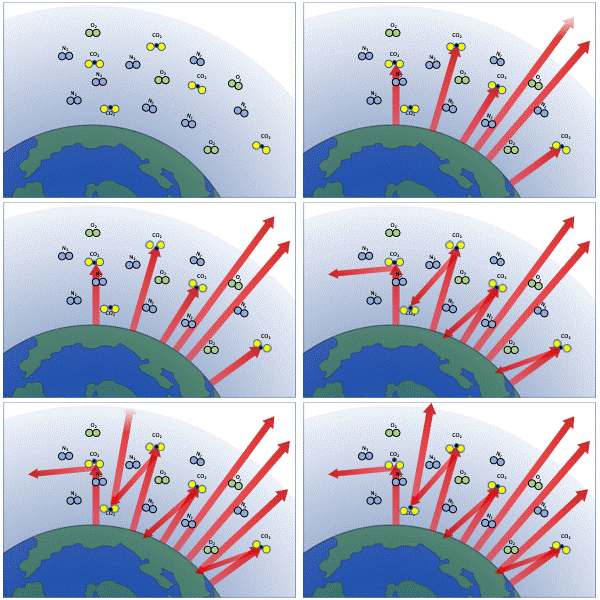
Well, out of all the gases in our atmosphere, the ones with three or more atoms, like H₂O, CO₂, CH₄, NH₃, etc, have molecular structures that like to absorb (and vibrate or dance!) and re-emit or radiate this infrared radiation in all directions (just like we love grooving to our favorite songs!). Some of this re-emitted radiation comes back towards the Earth and heats (or warms) it up, causing what we call Global Warming. And this phenomenon right here is called the ‘Greenhouse effect’ as it mimics how temperatures inside a greenhouse are warmer than the outside due to the glass trapping the hot air. The gases in the atmosphere that dance to infrared radiation are called ‘Greenhouse gases’.
With time, scientists could explain that a lot of Carbon Dioxide was already part of our early atmosphere, but it was not enough to keep the Earth as warm as it was. The secret extra ingredient was ‘Methane’, which is a much stronger greenhouse gas than Carbon dioxide (on a 100-year timescale, Methane’s global warming potential is ~30 times that of carbon dioxide and 82.5 times more on a 20-year timescale).
But the main question is- where did so much Methane come from??! If you have been following the previous posts of AlterEarth, you can guess where this is leading to- Early life on Earth.
Early life on Earth was anaerobic (living without oxygen), and some of the earliest microbes evolved metabolisms that consumed Carbon dioxide and released Methane into the atmosphere
The microbes that produced Methane from Carbon dioxide and Hydrogen are called Methanogens and this process is called Methanogenesis. They lived entirely underwater and Carbon isotope data from fossils suggests that Methane of biological origin (from microbes) dates back to ~3.5 billion years ago, confirming that the rise in Methanogen population led to the increase in Methane in the atmosphere.
The temperatures of the oceans around this period were estimated to be in the 55ºC - 85ºC range despite the weak Sun!
This was the work of a rising Methane percentage along with an already immense amount of Carbon dioxide in the atmosphere.
In simple words, these methanogens ‘unintentionally engineered’ a Global warming during the Faint Young Sun period that kept the Earth thriving with life and laid the foundation for further evolution that eventually led to us. Without them, the Earth would have been a frozen ball of ice (back then) and who knows if any of us would be here to read this now.
This is a clear example of how life on Earth can influence the coupled Earth system processes on a planetary scale in a positive way. The next post will talk about a very interesting phase in the Earth’s history- the next stage of evolution.
How was today’s post?
If you liked it, please hit the Like button at the bottom and share it with a friend. Hit the ‘send message’ button if you want to share feedback. Also, please Subscribe to AlterEarth if you haven’t already. Have a great day!
Here are the references that I used for figures and guidance while writing this piece.
References:
https://www.noaa.gov/jetstream/atmosphere/layers-of-atmosphere
https://earthhow.com/origin-of-water-comets-volcanoes-outgassing/
https://www.manchester.ac.uk/about/news/earths-atmosphere-came-from-outer-space-find-scientists/
https://astrobiology.nasa.gov/news/earths-early-atmosphere-an-update/
Avice, G., Marty, B. & Burgess, R. The origin and degassing history of the Earth's atmosphere revealed by Archean xenon. Nat Commun 8, 15455 (2017). https://doi.org/10.1038/ncomms15455
https://www.britannica.com/science/evolution-of-the-atmosphere-1703862
https://ugc.berkeley.edu/background-content/greenhouse-effect/
https://rwu.pressbooks.pub/webboceanography/chapter/8-1-earths-heat-budget/#:~:text=Just%20under%20half%20(47%25),phase%20change)(Figure%208.1.
https://niwa.co.nz/atmosphere/what-are-greenhouse-gases#:~:text=In%20general%2C%20any%20gas%20with,is%20quite%20a%20different%20effect.
https://eartharxiv.org/repository/view/108/
https://www.museumoftheearth.org/changing-climate/greenhouse-effect
https://energy.ec.europa.eu/topics/carbon-management-and-fossil-fuels/methane-emissions_en#:~:text=After%20carbon%20dioxide%2C%20methane%20is,comes%20from%20the%20energy%20sector
https://www.quantamagazine.org/the-sun-was-dimmer-when-earth-formed-how-did-life-emerge-20220127/
https://news.mit.edu/2018/mit-researchers-determine-timing-of-methanogen-evolution-0404
https://astrobiology.com/2026/01/methanogens-through-geological-time-and-space-impact-on-planetary-evolution-and-significance-for-life-beyond-earth.html
https://astrobiology.nasa.gov/news/how-hot-were-the-oceans-when-life-first-evolved/#:~:text=Earlier%20geological%20evidence%20has%20suggested,silicon%20isotopes%20in%20marine%20rocks.
Very cool! I think I do something similar on my blog
We both are focusing on similar topics, and I’m glad
good going! This is awesome