

As the universe was doing its thing, constantly creating new stars and the dying ones making new elements that eventually may or may not lead into new planets, something was brewing in a small, dusty and dark arm of the milky way galaxy.
The serendipitous birth of our Sun
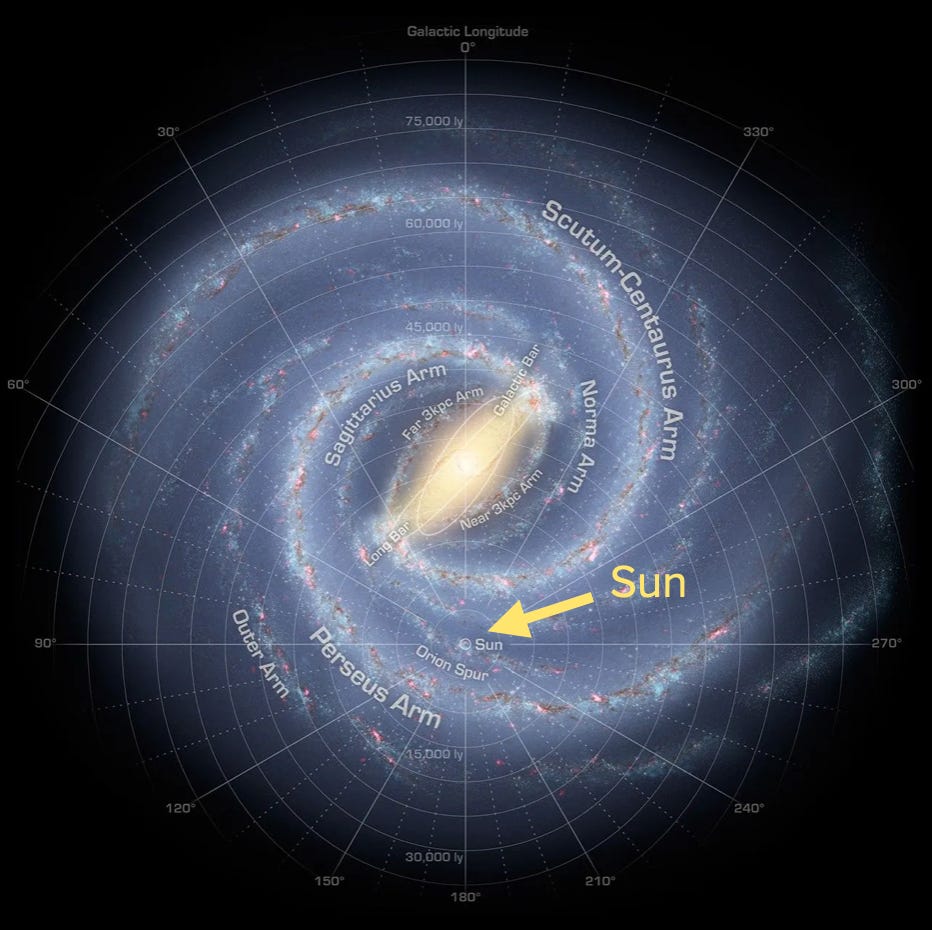
Billions of years ago, in a small part of the milky way galaxy called the Orion arm (Figure 1), extremely large clouds of dust and gas, called nebula, slowly started to come close to each other due to gravity. These specific clouds, were either very shy or lazy to get close enough to each other in masses and speeds that would create the perfect ground for nuclear fusion.
Meanwhile, a little before 4.6 billion years ago, somewhere in a region beyond this lazy nebula, an old star exploded in a massive supernova, emitting energy and hurling out the elements it created in all directions at high speeds. Some part of this energy and newly ejected material, full of kinetic energy, came as a shockwave directly into this lazy nebula and shook things up for good! This kick of energy and matter stirred up the contents in this lazy nebula, compressing (increasing its density) it in certain regions, just enough for gravity to take over, creating conditions for nuclear fusion that eventually led to the formation of our Sun (nearly 4.6 billion years ago).
The creation of our Earth (sizzling hot beginnings)
After our Sun was born, its intense gravity pulled almost all the material of the nebula towards itself and these clouds of dust and gas (protoplanetary disk) started to revolve around the sun at high speeds. With time, the protoplanetary disk started to cool down and solidify. The very dense material of the protoplanetary disk, consisting of all kinds of elements that we see in the planets today, eventually bumped into each other, forming progressively heavier bodies- from meteors (meters in width) to asteroids (meters to kilometers in width) and planetesimals (hundreds of kilometers in width).
In a few tens of millions of years after the formation of our Sun, many of these solid planetesimals collided into each other at rapid speeds forming our Earth and other inner rocky planets of our Solar system, in a process called planetary accretion (nearly 4.54 billion years ago).
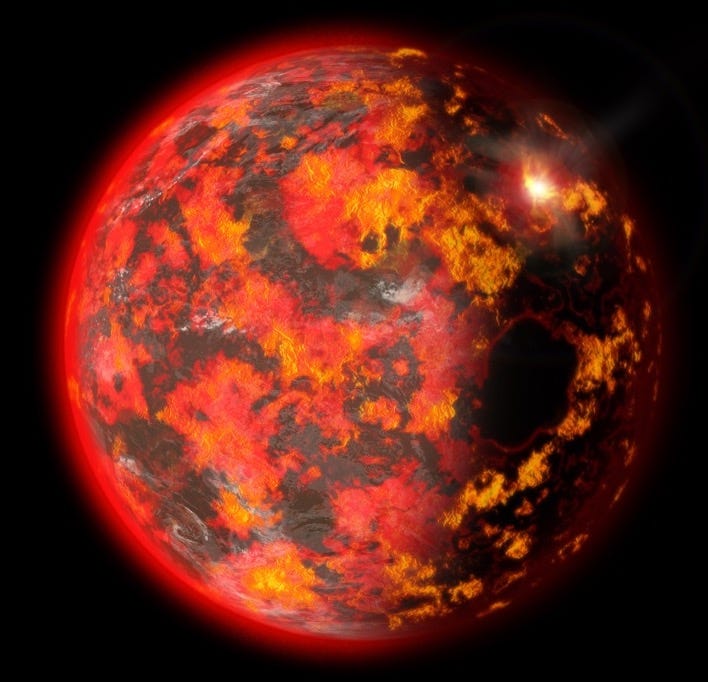
When we strike two stones against each other, we can observe some sparks, and similarly, briskly rubbing our palms against each other generates heat. Now, imagine the same processes happening at a huge scale during planetary accretion. The Proto-Earth that was formed as a result of all these collisions was a piping hot ball of material all lumped together (much higher than 1000ºC) (Figure 2).
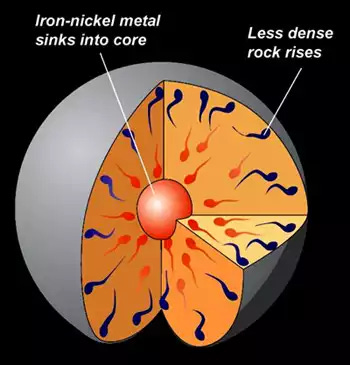
During this molten phase (heat from a number of collisions and decay of radioactive elements), the contents of our Proto-Earth had undergone a massive reorganization. Heavier elements like Iron and Nickel sunk in towards the center of the Earth, forming its Core, and lighter ones like Silicates and everything else came to the top, forming the Mantle (largest part of Earth between the Core and surface) and a very early, thin and unstable Crust (solid surface of the Earth) in a process called planetary differentiation (Figure 3).
This hot ball of molten rock or Proto-Earth, while trying to cool down, got hit by another Mars-sized planetesimal called Theia around 100-150 million years after its formation, which broke a chunk of our young planet and heated and remelted it even more. The chunk that broke out of our planet eventually went on to form our Moon. The extra heat due to this collision helped in the final stage of planetary differentiation (hotter materials move faster).
First atmosphere and oceans (4.5 - 3.8 billion years ago)
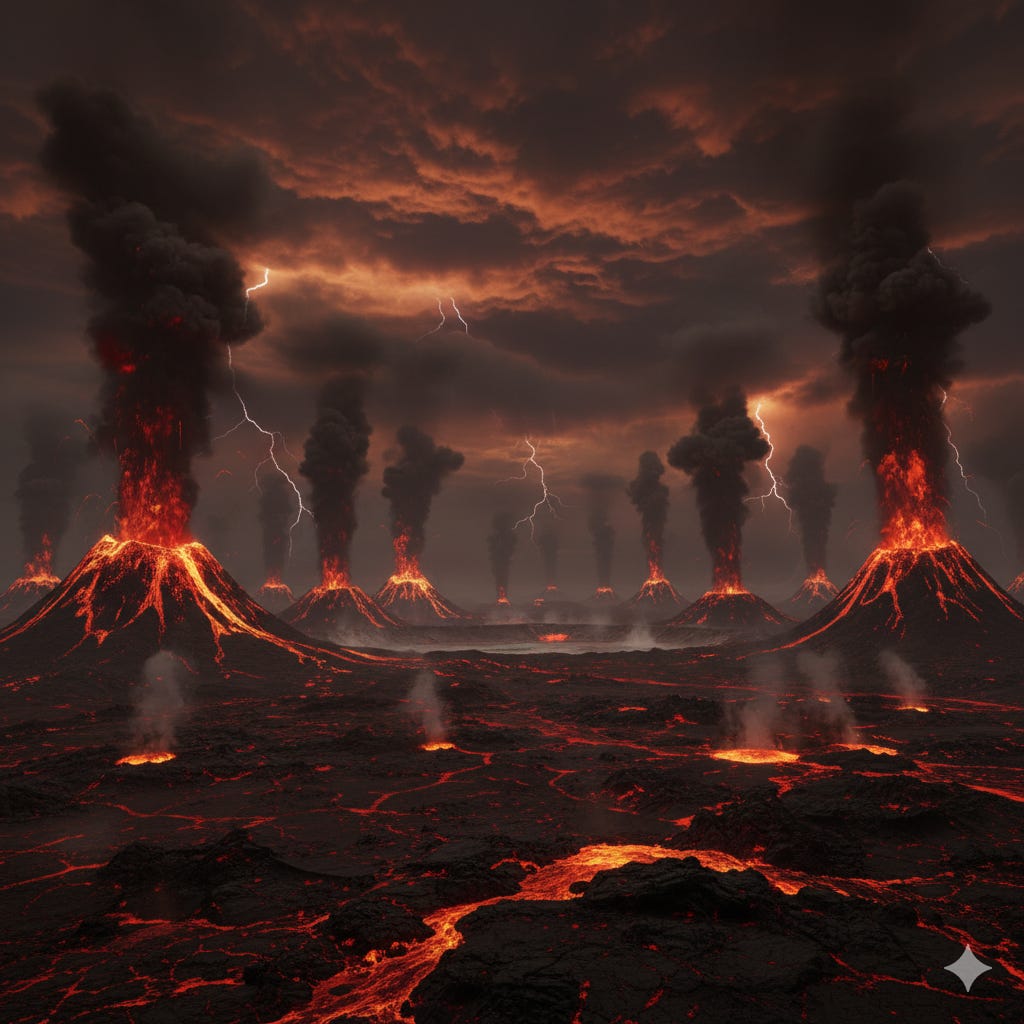
The early Earth at this stage had no atmosphere or water like today. Millions of years after the differentiation process, the Earth was cooling down and the crust started to solidify while temperatures were still in the 100s of ºC range. This process is similar to a thin layer of solid skin forming on hot milk as it cools off. As the newly formed crust was very thin and the Mantle was very dynamic, there was intense volcanic activity everywhere on Earth, which brought both solid material and gases from the mantle onto the surface in a process called volcanic outgassing (Figure 4). This massive emission of gases is what created the first atmosphere on Earth.
The main contents of our early atmosphere were:
Water vapor (H₂O)
Carbon dioxide (CO₂)
Nitrogen (N₂)
Other gases like methane (CH₄), ammonia (NH₃), and sulfur dioxide (SO₂).
Oxygen in its free form was not present in our atmosphere until much later!
Millions of years after the first atmosphere kept accumulating, the Earth cooled down to temperatures below 100ºC. This cooling, in combination with the pressures being low enough, facilitated the precipitation (or rainfall) of immense amounts of water vapor (H₂O) in the atmosphere. This intense rainfall that lasted for multiple centuries or maybe millions of years created the world’s first oceans (nearly 4 billion years ago). There are also some theories that say most of the water on the planet was brought by comets and asteroids. Some works propose that it might be the combination of the two processes. Whatever the cause of water’s origin on Earth, its existence is the reason our planet appears as a Pale Blue Dot from outer space (Figure 5).

From the tallest of mountains to the deepest of oceans, the lands home to gigantic dinosaurs and blue whales, are parts of a planet that is just a speck of dust or a Pale Blue Dot in the cosmic scale. In other words, the creation of our Earth was a mere act of cosmic insignificance that led to hosting trillions and trillions of life forms over billions of years, all of which happened by chance as all the building blocks were at the right place at the right time. Despite its insignificance, this Pale Blue Dot is the only known world (out of thousands we identified) that is home to life!
While the atmosphere and oceans were created on the surface of the Earth in the first 800 million years of its creation, something else was happening deep inside the Earth, something that helped sustain all that was created on the surface. Let us dig deeper into it in the next post.
How was today’s post?
If you liked it, please hit the Like button at the bottom and share it with a friend. Also, please Subscribe to AlterEarth if you haven’t already. Have a great day!
Here are the references that I used for figures and guidance while writing this piece.
References:
https://science.nasa.gov/sun/facts/
https://www.space.com/35151-supernova-trigger-solar-system-formation.html
https://science.nasa.gov/resource/the-milky-way-galaxy/
https://www.britannica.com/place/Earth/Accretion-of-the-early-Earth
https://science.nasa.gov/earth/facts/
https://www.universetoday.com/articles/the-moon-might-be-one-large-chunk-that-was-blasted-off-the-earth-billions-of-years-ago#:~:text=The%20widely%2Daccepted%20view%20is,between%20Earth%20and%20its%20Moon.
https://www.britannica.com/science/evolution-of-the-atmosphere-1703862
https://www.britannica.com/science/geologic-history-of-Earth/Development-of-the-atmosphere-and-oceans
https://oceanservice.noaa.gov/facts/why_oceans.html
https://science.nasa.gov/solar-system/comets/nasa-led-team-links-comet-water-to-earths-oceans/
https://www.abc.net.au/news/science/2020-08-28/where-did-earths-water-come-from/12598198
https://science.nasa.gov/mission/voyager/voyager-1s-pale-blue-dot/
Seriously, your take on the Sun's birth story is so clear and makes perfect sens.