

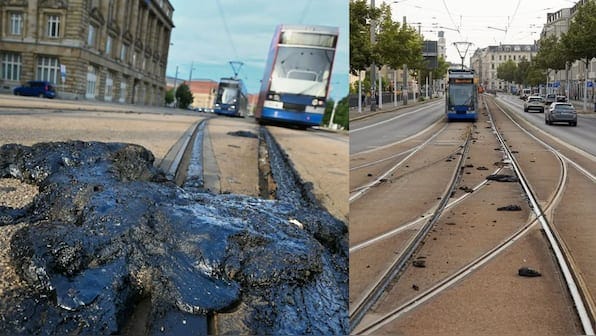
Recently, we have come across pictures on social media of melted tram track sealants in Germany, along with hundreds of thousands of people dying from heat-related causes around the world every year. Air conditioners and heaters are not the only ways to keep indoor spaces comfortable, like we think they are. The levels of heat we are currently facing were previously unheard of, and the infrastructure that currently exists was not built to handle it.
In today’s iteration, we are going to talk about a really interesting source of energy that lies beneath the ground (Geothermal energy), which has the potential to be a promising solution to our ventilation problem. Dig a few meters into your garden (about 8 to 15 meters) and something strange happens: while the air above lurches from a freezing winter night to a blistering May afternoon, down there the temperature barely flinches.
The cellar that never changes
Our grandparents knew this instinctively: a step-well or root cellar held its contents steady through both seasons. Soil and rock are thermal sluggards: they take up heat slowly and release it just as slowly. Summer's warmth takes weeks to seep a few meters down, arriving weakened and out of season, and by about ten meters the seasonal swings cancel out entirely. Below about ten meters, the ground simply holds the year’s average temperature, a kind of thermal memory.
In India, surface air drops below 0°C in the northern winter and nears 50°C in a heatwave, yet a few meters down it holds steady at roughly 16 to 24°C all year round. That’s almost exactly what we spend fortunes manufacturing indoors using air conditioners.
The shallow Earth is a giant, free thermal battery: cool in a summer day, warm on a winter night.
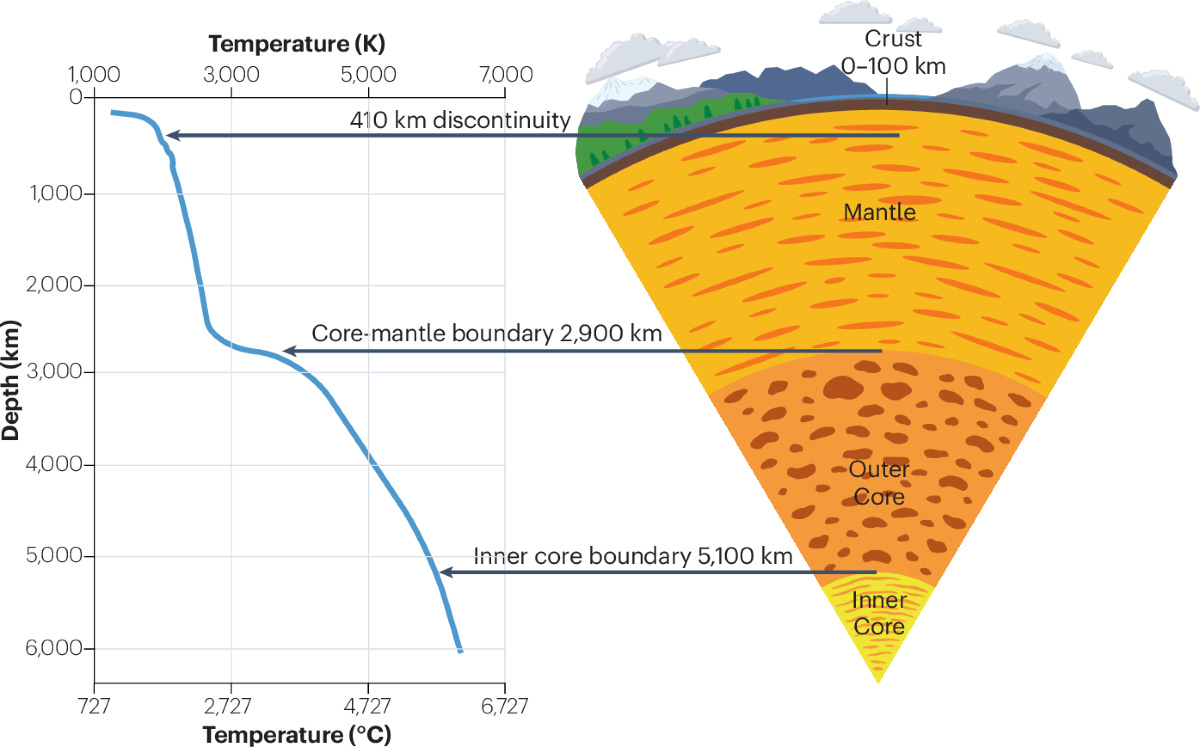
That steadiness, though, is only skin-deep. The calm comes from the ground settling at roughly the yearly average surface temperature, an equilibrium set mainly by sunlight rather than by heat from Earth’s interior. Drill deeper and you meet Earth’s true furnace: the temperature climbs by about 25 to 30°C every kilometer, down through crust and mantle to a solid-iron core thought to sit near 6,000°C, roughly as hot as the surface of the Sun. This is kept glowing by leftover heat from the planet’s birth and steady radioactive decay. Shallow geothermal only sips from that calm upper skin. The fire below (deep Geothermal energy) is a story for another day.
A fridge running in reverse
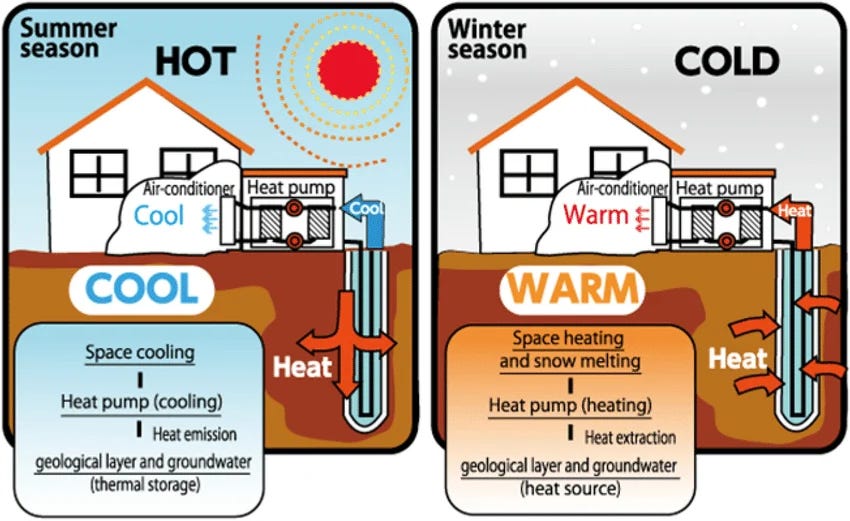
So how do we tap it? A Ground-Source Heat Pump (GSHP) is a refrigerator working backward. A fridge doesn’t make cold. It pumps heat from its interior into your kitchen. A heat pump does the same, but chooses which side is which.
The engine is a refrigerant circulating in a sealed loop. Squeeze a gas and it heats up. Let it expand and it cools. Working that cycle, the pump gathers gentle warmth in one place and releases it concentrated in another: in winter drawing it from the soil to warm the home, in summer reversing to push the home’s heat into the cool ground instead of the baking air outside.
The trick: the pump moves heat rather than making it, so you get out far more than you put in, much as moving water uphill costs less than boiling it. The Coefficient Of Performance (COP) measures it: a good GSHP gives 3 - 5 units of heating or cooling per unit of electricity, while a plain electric heater gives you one. This is shallow geothermal energy: warmth from the Earth’s top few hundred meters, no volcanoes or hotspots required.
One catch makes or breaks all this. A heat pump works gently, delivering heating or cooling at temperatures close to the room’s own rather than blasting it out like an AC, so it only keeps you comfortable if the building holds onto what it’s given. Pour water into a leaky bucket and no matter how fast the tap runs, the level settles too low to be useful. Similarly, a drafty, uninsulated home bleeds heat in winter and soaks it up in summer faster than the pump can supply it, and the COP advantage drains away. Good insulation and sealing are the thermos that lets the whole system work optimally, which is exactly why heat pumps spread first through the well-built homes of cold countries.
From Iceland to Sweden
Iceland is the geothermal poster child: 85 to 90% of its homes are heated geothermally, with pipes delivering it to 95% of the population. But it sits on a volcanic seam, scalding water near the surface, an advantage most countries weren’t gifted with.
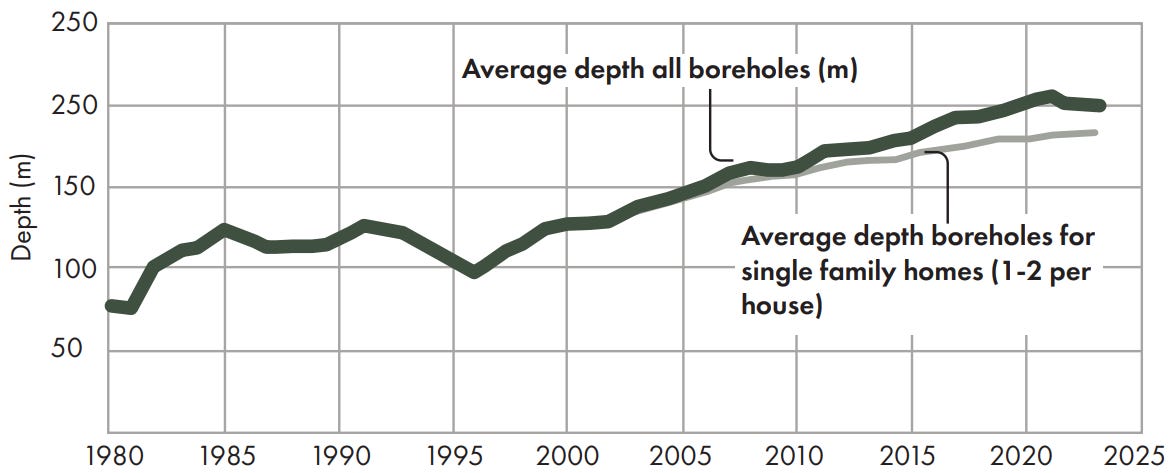
Sweden tells the quieter, universal story. With no volcanoes, it has installed over half a million shallow geothermal systems, roughly one home in five. The lesson: this works almost anywhere there’s ground. Worldwide, humble buried loops, not dramatic plants, supply over half of all direct geothermal use.
India’s (now Europe’s) long summer
India is heating up and reaching for the air conditioner: already roughly 110 million room ACs, with ownership set to rise ninefold by 2050.
An ordinary AC is itself a heat pump, a clumsy one that can only dump your room’s heat into the outdoor air. On a 45°C afternoon that air is a terrible place to put it, so the machine strains and guzzles. Worse, the exhausted heat turns cities into ovens, pushing everyone to run ACs harder still. Each 1°C rise now adds about 7 gigawatts to India’s peak demand, straining grids and bills when families can least afford it.
A ground-source system sidesteps the trap: instead of wrestling with scorching air, it hands the heat to the steady earth at around 22°C. With a smaller gap to bridge, it sips electricity where an AC gulps, and stops pouring heat into the street. Same comfort, smaller bill, calmer city. Note that it is also important to plan, before installation, how the heat plume (the warm or cool patch of ground that slowly builds up around the buried pipes) evolves over time and affects system efficiency.
A calmer thermostat
We’ve seen the planet regulate its temperature from the outside: winds in the atmosphere, currents in the deep ocean. It turns out Earth keeps a second, steadier, and a more sustainable thermostat beneath our feet. As we warm the world and crank our ACs against it, that quiet ground offers a gentler way to stay cool, if we choose to dig.
How was today’s post?
If you liked it, please hit the Like button below and share it with a friend. Hit the message button if you want to share feedback, and please Subscribe to AlterEarth if you haven’t already. Have a great day!
References
Sivasakthivel, T., Murugesan, K., & Sahoo, P. K. (2014). A study on energy and CO₂ saving potential of ground source heat pump system in India. Renewable and Sustainable Energy Reviews, 32, 278–293. https://doi.org/10.1016/j.rser.2014.01.031
Sivasakthivel, T., Murugesan, K., & Sahoo, P. K. (2015). Study of technical, economical and environmental viability of ground source heat pump system for Himalayan cities of India. Renewable and Sustainable Energy Reviews, 48, 452–462. https://doi.org/10.1016/j.rser.2015.04.008
Sarbu, I., & Sebarchievici, C. (2014). General review of ground-source heat pump systems for heating and cooling of buildings. Energy and Buildings, 70, 441–454. https://doi.org/10.1016/j.enbuild.2013.11.068
Lund, J. W., & Boyd, T. L. (2016). Direct utilization of geothermal energy 2015 worldwide review. Geothermics, 60, 66–93. https://doi.org/10.1016/j.geothermics.2015.11.004
Huang, S. (2025). How hot is the inside of the Earth? Nature Reviews Earth and Environment, 6, 437. https://www.nature.com/articles/s43017-025-00698-3.
Kana, J.D., Djongyang, N., Zakari, A. et al. GIS based exploring of low-enthalpy geo-energy potentials in the Subsaharan area in Central Africa. Geomech. Geophys. Geo-energ. Geo-resour. 7, 94 (2021). https://doi.org/10.1007/s40948-021-00290-1.
International Energy Agency: Staying cool without overheating the energy system. https://www.iea.org/commentaries/staying-cool-without-overheating-the-energy-system
International Energy Agency: The Future of Cooling. https://www.iea.org/reports/the-future-of-cooling
Orkustofnun (National Energy Authority of Iceland): District heating. https://orkustofnun.is/en/natural_resources/district_heating
REHVA Journal: Geothermal energy use in the Nordic countries. https://www.rehva.eu/rehva-journal/chapter/geothermal-energy-use-in-the-nordic-countries
U.S. Department of Energy, Energy Saver: Geothermal Heat Pumps. https://www.energy.gov/energysaver/geothermal-heat-pumps
CLASP: India Raises AC Efficiency Amid Growing Demand. https://www.clasp.ngo/about/insights/india-raises-ac-efficiency-amid-growing-demand/
https://geoexpro.com/shallow-geothermal-in-sweden-a-deep-penetration-in-the-geo-energy-market/