

We are surrounded by magnets in our daily lives- from the ones in our earphones or speakers, in fans, blenders, washing machines, the black stripe on our debit and credit cards, inside fridges, and many more. These are modern conveniences that were slowly integrated into our lives through technology. But, did you know that the most important magnet on the entire planet is very dynamically active and huge! It is located deep inside the Earth and acts as an invisible shield that protects everything on the surface, and causes the magnificent Auroras!
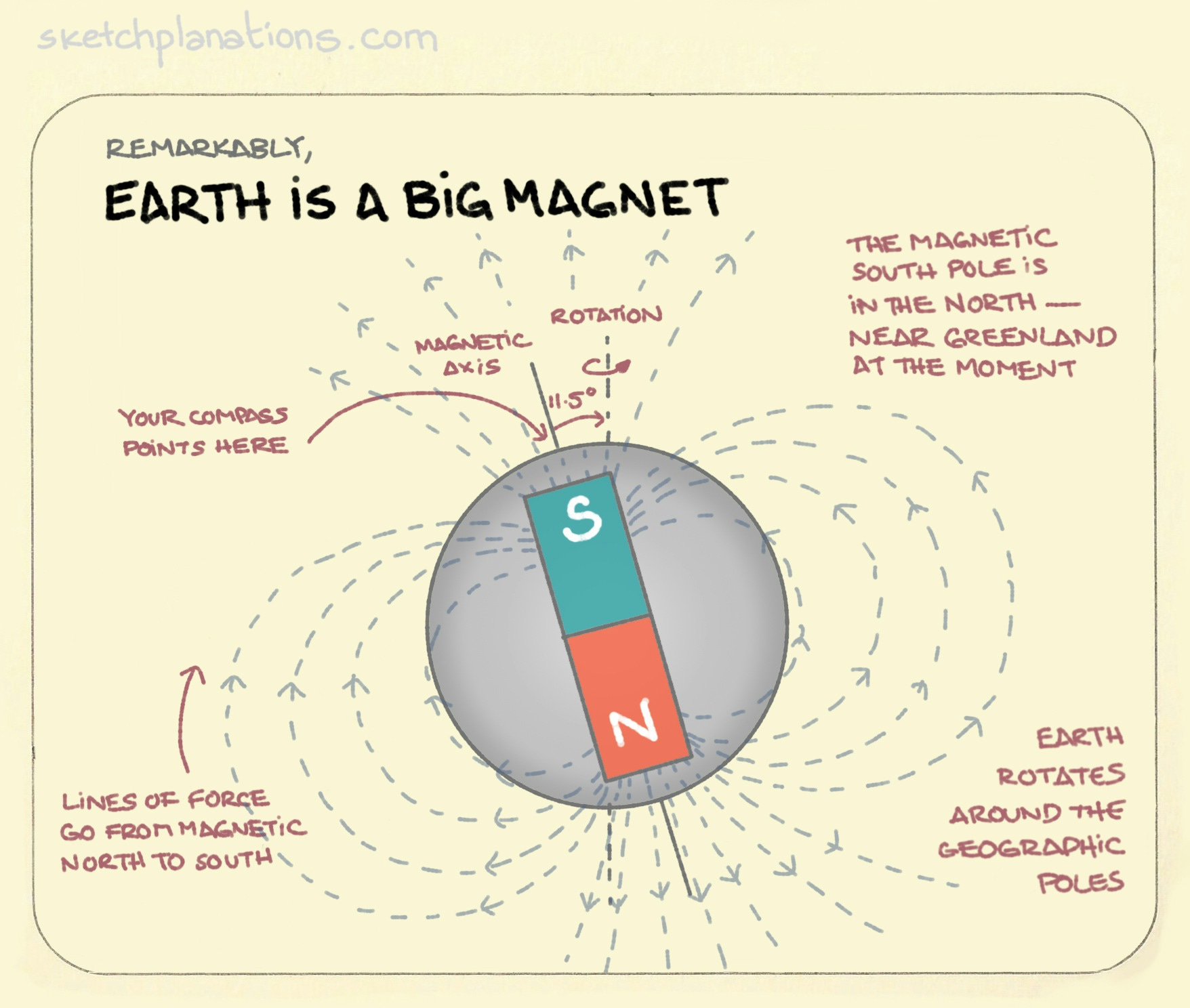
In our last post, we saw how the Earth was created and how it was a piping hot ball of material mixed up together. With time, planetary differentiation segregated the material into different layers where heavier material sunk in to form the core and lighter materials came up. This is what led to the current internal structure of the Earth.
Internal structure of the Earth (and origin of the giant magnet)
If you start drilling from one point on the Earth and keep drilling in a straight line until we reach the other end of the planet, it takes nearly 12,700 km to get there. Our Earth is not a perfect sphere though, it is an oblate spheroid that is somewhat flat at the poles and bulged at the equator. But, for simplicity and calculation purposes, we consider it to be a sphere of radius around 6371 or 6400 km.
Let us begin our journey from the center of our Earth- we are inside the hottest part of our planet, the solid inner core (from 5155 km to 6371 km deep). It is mainly composed of Iron and Nickel, and gets as hot as around 6000ºC at the center, which is more or less the temperature on the surface of our Sun!!
As we move upwards towards the surface, we can see a phase transition from solid to liquid when we reach the outer core (from 2885 km to 5155 km deep), which has more or less the same composition of the inner core, but also a bit of Oxygen and Sulphur in temperatures ranging from around 2900ºC - 4000 or 5000ºC.
Moving further upwards, we encounter the mantle, which is the largest part of the Earth that makes up around 84% of the planet ranging from around 100 km to 2885 km deep with temperatures ranging from about 900ºC to 2900ºC. This part of the Earth is much richer in composition compared to the core. The mantle is dynamic, not as much as the liquid outer core, but its material also moves very slowly in convection cycles (hot material moves up and colder material moves down). Finally, the last layer is the tiny crust that we all are standing on that ranges from 0 to around 100 km deep and is the smallest part of the Earth. This tiny crust of solid rocks shields us from all the heat deep under the surface.
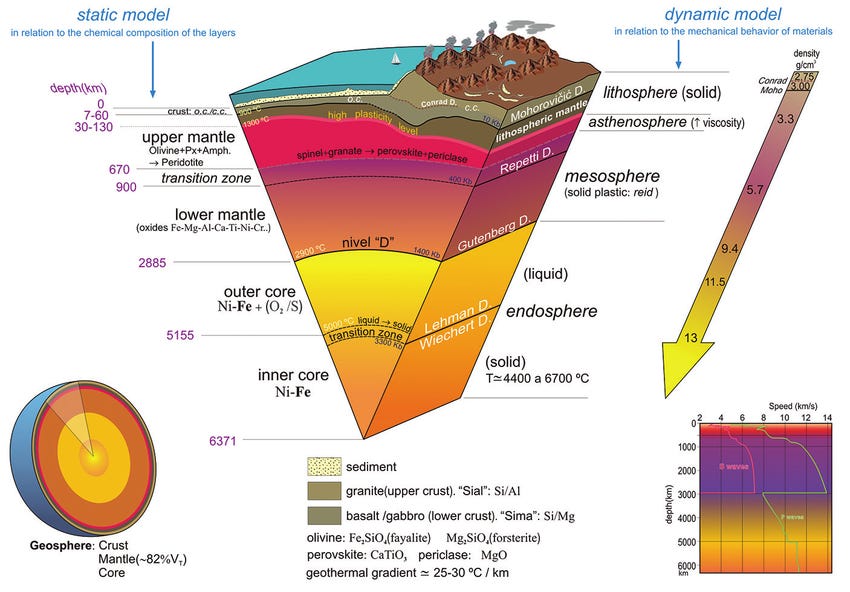
We will get into more details of the Mantle and Crust in a later post. But for now, the hero of this post is the outer core, i.e, the Giant Earth Magnet.
How do Magnets actually work?
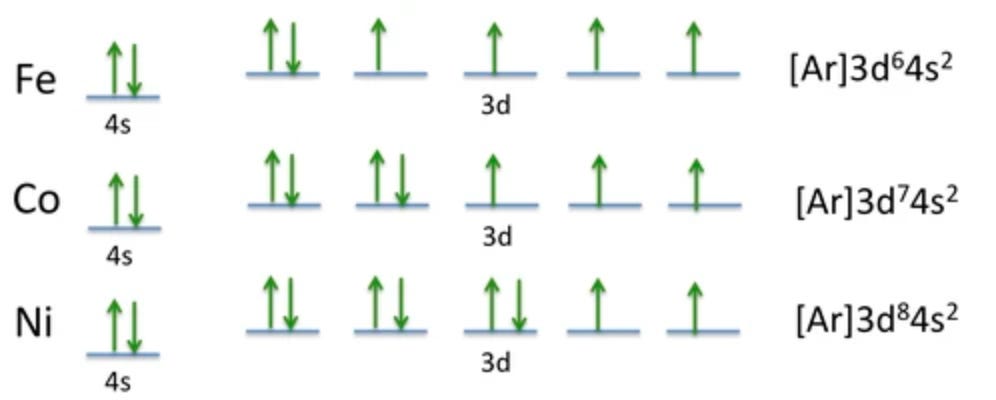
Every stable atom has tiny electron/s revolving around the nucleus at very high speeds. Each of these electrons have their own ‘spin’ while circling the nucleus. In most of the elements, the spin (either +1/2 and -1/2) usually cancels out as the electrons move in random directions.
In the figure below, each tiny house (blue underline), also known as an orbital, host a maximum of two electrons. The number preceding the letter (like ‘4’s and ‘3’d) denotes how far away the electrons are from the nucleus, with ‘4’ being farther than ‘3’ and the letters- s, p, d and f (only s and d here) have a predefined shape in the 3D space around the nucleus where the electron has a maximum probability to be found at.
Metals like Iron, Cobalt, Nickel, etc, have several unpaired electrons with the same spin, which makes each of the unpaired electron, and thereby the atom, behave like a tiny magnet. But, for something to be really meaningful and have a tangible impact, large numbers are required- just like drops of water in an ocean or trillions of atoms of a magnetic element (with similar spin electrons) are needed to form what is called a magnetic domain (these may be disoriented or oriented).
The materials with these disoriented magnetic domains need to be magnetized by passing a strong magnetic field through them. This magnetic field forces the magnetic domains to be aligned in the direction of the magnetic field and creates permanent magnets like the ones in all of our appliances.
If we need a strong magnetic field to create magnets, how were natural magnets created?
A very simple one worded answer to this question is ‘lightning’. As we studied in high school, a lightning strike is a massive electric discharge from the charged particles in clouds that hits the ground. Also, an electric current creates a magnetic field around it due to the movement of charged particles in a certain direction, and hence, lightning also creates a very strong magnetic field.
When a specific type of iron ore called magnetite is exposed to the surface and struck by lightning, the intense magnetic field aligns the previously disoriented magnetic domains in the magnetite and converts it to lodestone, the only ‘natural permanent magnet’.
The big Earth magnet!
We have established that we need a ‘push’ induced by a strong external magnetic field to create a permanent magnet from naturally magnetic materials (most common ones being Iron, Cobalt and Nickel) that have these magnetic domains. And guess what we have loads and loads of in the Inner and Outer Core- Iron and Nickel!
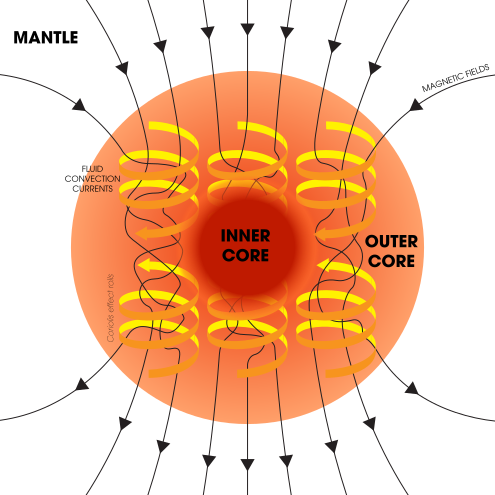
The inner core is solid because the immense pressure from the layers above it increases the melting point of the metals inside it. The outer core however, is in a liquid state and the materials (mostly Iron and Nickel) keep moving due to the rotation of the Earth and density differences due to variations in temperature. Where did the outer core get its magnetism from?? This continuous circulation and movement of gigantic amounts of charged particles in the outer core induces a large magnetic field that led to creation of the Earth’s self-sustaining magnetic field or Geodynamo.
When the outer core was newly created, the Sun was very young as well and had a weak magnetic field of its own. The Sun has immense quantities of super-hot ions and charged particles called plasma. This solar plasma is continuously in motion due to the Sun’s rotation and internal convection currents. With time, the Sun’s magnetic field became stronger and it started to eject its plasma, harmful radiation and strong magnetic fields out into the space. The magnetic field generated by the outer core of our Earth acts as a protective shield that deflects all these harmful radiation and particles emitted by the Sun.
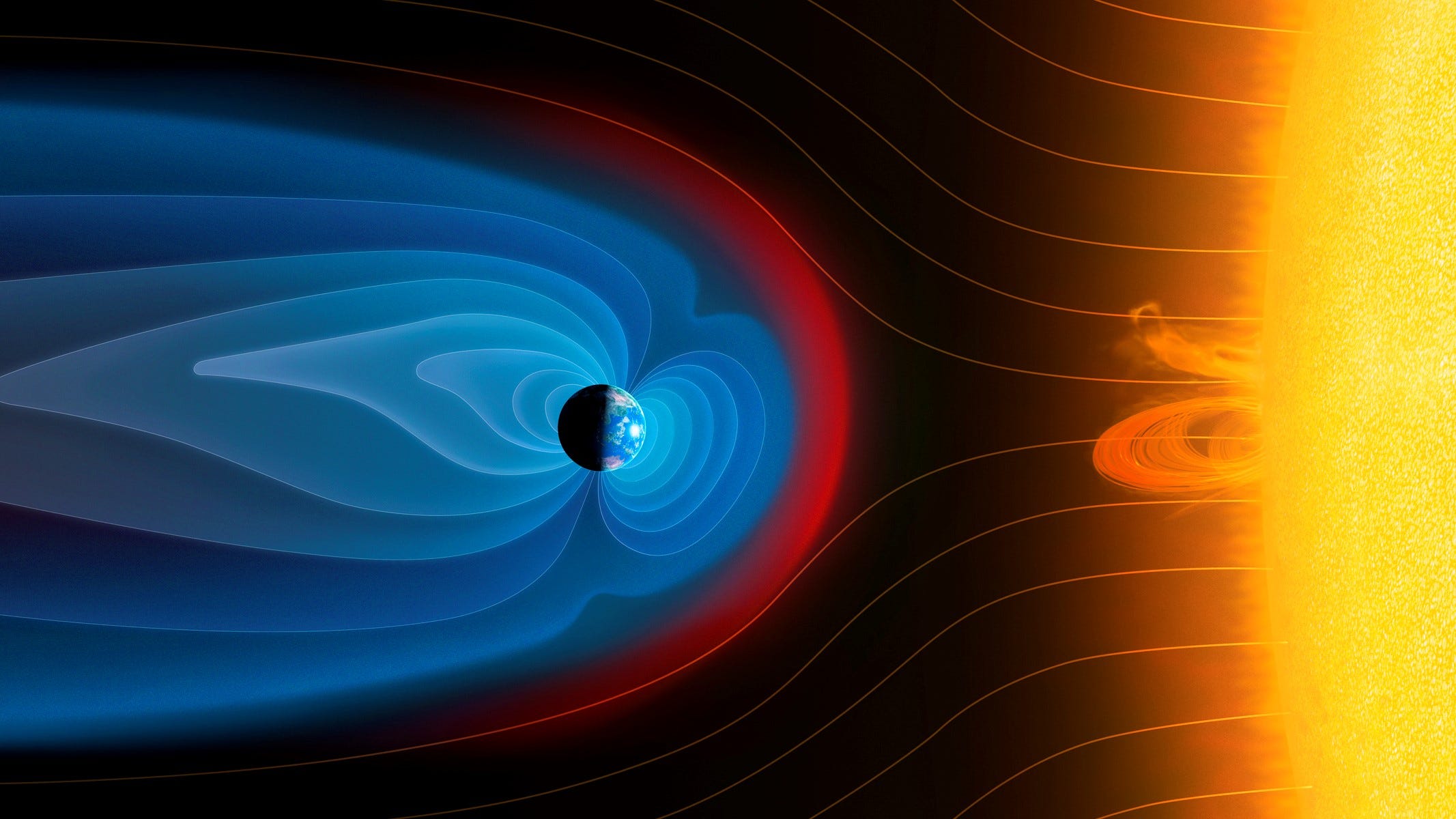
If we had no Geomagnetic field, the solar radiation would strip away our atmosphere and all the water on the surface of our Earth in a slow process over millions of years. But, the harmful radiation and particles would impact surface life causing diseases like cancer to be more prevalent and significantly impacting all life in a span of centuries if not decades. So, this Geomagnetic field (magnetosphere) generated by the large Magnet in the outer core literally saves us all!
Our neighboring Red planet (Mars) had a magnetic field of its own a long time ago, but the shutting down of this magnetic field has led to the planet losing its atmosphere and all of its surface water in a slow process.
How is the Magnetosphere related to Auroras?
The magnetic field lines of our magnetosphere converge at the magnetic north and south poles. The shape of the magnetosphere at the magnetic poles allows some of the solar particles to funnel down into the upper atmosphere and interact with particles (usually Oxygen and Nitrogen) in our own atmosphere (Ionosphere).
When solar particles collide with gases in our atmosphere, the atoms of gases tend to get ‘excited’ due to energy provided by the collision. As any ‘excited’ thing or person needs to get back to normal conditions, these gases emit the extra energy as light in the visible wavelength. The green color we see in auroras is cause by Oxygen getting ‘de-excited’ and the shades of purple, blue and pink are cause by excited Nitrogen getting back to normal ways.
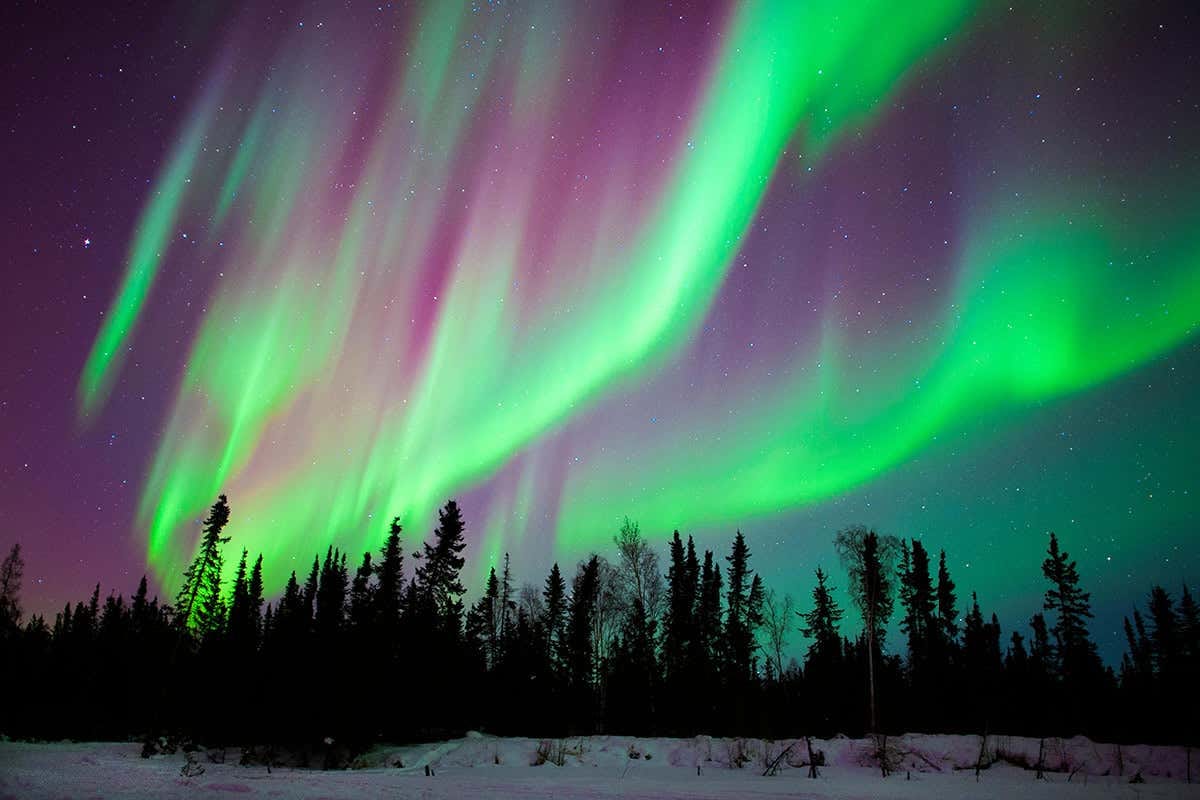
So the next time you see the captivating Auroras and get ‘excited’, remember that the beautiful colors are emitted by gases that are ‘tired of being excited’ and want to go back to business as usual.
In the upcoming posts, we will explore more details about the shallower parts of the Earth and some of their deeply hidden secrets.
How was today’s post?
If you liked it, please hit the Like button at the bottom and share it with a friend. Also, please Subscribe to AlterEarth if you haven’t already. Have a great day!
Here are the references that I used for figures and guidance while writing this piece.
References:
https://sketchplanations.com/earth-is-a-big-magnet
Gervilla, Fernando & González-Jiménez, Jose & Hidas, Károly & Marchesi, Claudio & Piña, Rubén. (2019). Geology and Metallogeny of the Upper mantle Rocks from the Serranía de Ronda. https://www.researchgate.net/publication/334132194_Geology_and_Metallogeny_of_the_Upper_mantle_Rocks_from_the_Serrania_de_Rondaç
https://education.nationalgeographic.org/resource/mantle/
https://www.space.com/earths-magnetic-field-explained
https://www.chemguide.co.uk/atoms/properties/atomorbs.html
https://www.eia.gov/energyexplained/electricity/magnets-and-electricity.php
https://www.sciencedirect.com/science/article/abs/pii/S0926985123003038
https://geomag.nrcan.gc.ca/mag_fld/fld-en.php
https://science.nasa.gov/science-research/earth-science/earths-magnetosphere-protecting-our-planet-from-harmful-space-energy/
https://www.rmg.co.uk/stories/space-astronomy/what-causes-northern-lights-aurora-borealis-explained#:~:text=This%20content%20is%20hosted%20by,in%20the%20Earth’s%20magnetic%20field.
https://www.newscientist.com/article/mg24432590-500-see-the-northern-lights-or-aurora-borealis-follow-this-easy-guide/