

Pause for a moment and take a look around the room. The plastic case on your phone, the polyester in your shirt, the lip balm in your pocket, and maybe the tablets in your medicine drawer all began as the same thing. They were the bodies of microscopic sea creatures that died and sank to the seafloor of ancient oceans long vanished.
A gently cooked graveyard
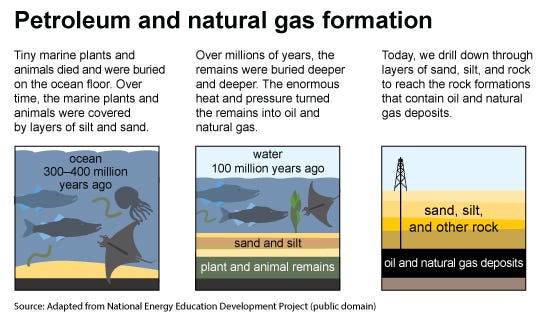
Where does oil actually come from? Hundreds of millions of years ago, ancient seas were swarmed with plankton. They were the tiny plants and animals that drift with the ocean currents and most of them far too small to see. When they died, they sank into still, oxygen starved mud where nothing could rot them away. More layers piled on top, and heat and pressure slowly climbed.
As the buried remains sank deeper, roughly two to four kilometers down, temperatures reached a narrow sweet spot geologists call the oil window, about 60°C to 120°C. This somewhat resembles a pressure cooker. If it was too cool, the remains would have stayed as a waxy solid called kerogen. Too hot, and they break apart into natural gas. Right in the middle, over tens to hundreds of millions of years, kerogen slowly cracks into liquid crude oil.
But where does the energy locked inside that oil come from? While alive, the plant-like plankton did what all plants do, they caught sunlight and stored it as food through photosynthesis. That is where we get our energy from when we eat our fruits and veggies. When plant-like plankton died and were buried, that trapped sunlight (in the form of energy) went down with them.
Simply put, oil is ancient sunlight, captured by plankton and then buried and pressure cooked for millions of years.
Here is the part that should make you think. More than half of the world’s oil formed in just two chapters of Earth’s history, the Jurassic and Cretaceous, the age of the dinosaurs. So oil is not made of dinosaurs at all. It is made of the plankton that drifted through the warm seas beside them.
One barrel wears a thousand masks
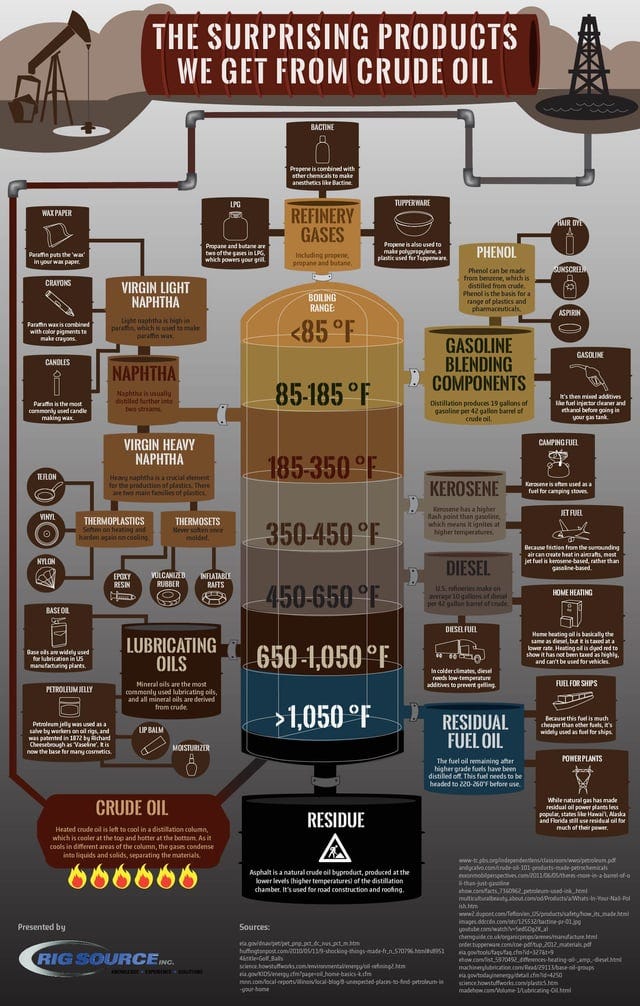
So how does a thick black liquid become a clear jelly, a t-shirt, and a painkiller? Because crude oil was never one chemical. It is a crowd of different hydrocarbons, molecules built from carbon and hydrogen, all jumbled together. At a refinery the crude is heated so its ingredients separate by weight, the light ones rising as vapor, the heavy ones sinking, much like oil and water settling in a jar. This sorting is called fractional distillation.
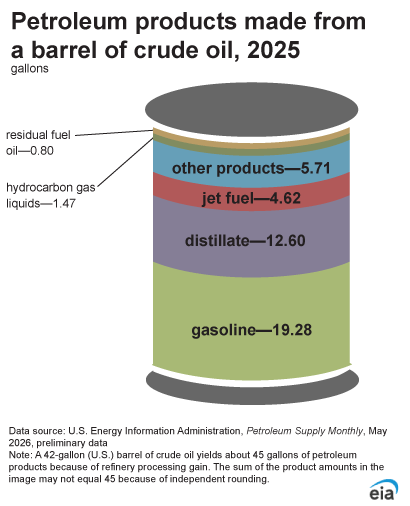
The best known fractions become the fuels you burn, petrol, diesel, and jet fuel. But burning is only half the story. The International Energy Agency reports that about 12 percent of the world’s oil is never burned at all. It becomes raw material for factories, and this is where crude oil quietly enters your home.
For example, petroleum jelly. In 1872 a chemist named Robert Chesebrough patented Vaseline after watching oil drillers smear a waxy petroleum residue on their wounds. And plastic. A fraction called naphtha is cracked into a light gas, ethylene, whose molecules then link into long chains, a process called polymerization, to build polyethylene, the most common plastic on Earth.
n C₂H₄ → (C₂H₄)ₙ
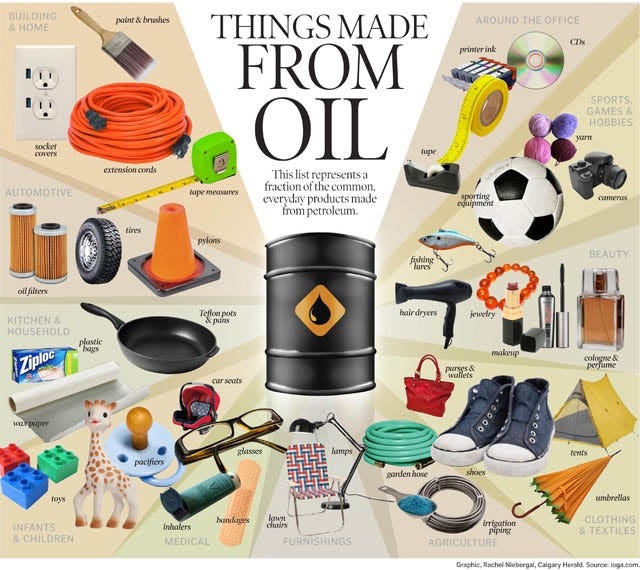
Your polyester shirt is the same kind of chemistry spun into thread, and synthetic fibers now make up close to two thirds of all fabric produced worldwide. Even your medicine cabinet is not left out. Petroleum building blocks such as benzene are the starting point for a large share of modern drugs, from aspirin to paracetamol.
The bill is always due
If oil is this useful, why worry? Because our dependence carries a cost, and it is not paid in money.
Starting with how it impacts the air. Burning petroleum and its derivatives releases tiny particles called PM2.5, small enough to slip deep into your lungs and bloodstream. A 2021 Harvard led study estimated that pollution from burning fossil fuels caused roughly 8.7 million premature deaths in a single year, close to one in five deaths worldwide. Benzene, the very same block behind our plastics and medicines, is a proven human carcinogen tied to leukemia.
Then there is the plastic that never truly leaves. We make over 400 million metric tons of plastic every year, and it is turning up everywhere (in whole and in fragments). Researchers have found microscopic plastic fragments (microplastics) in seawater, in the fish on our plates, and, more unsettling still, inside human blood and even the placentas that feed unborn babies. This has to make you think twice or thrice before buying food that is directly wrapped in plastic!
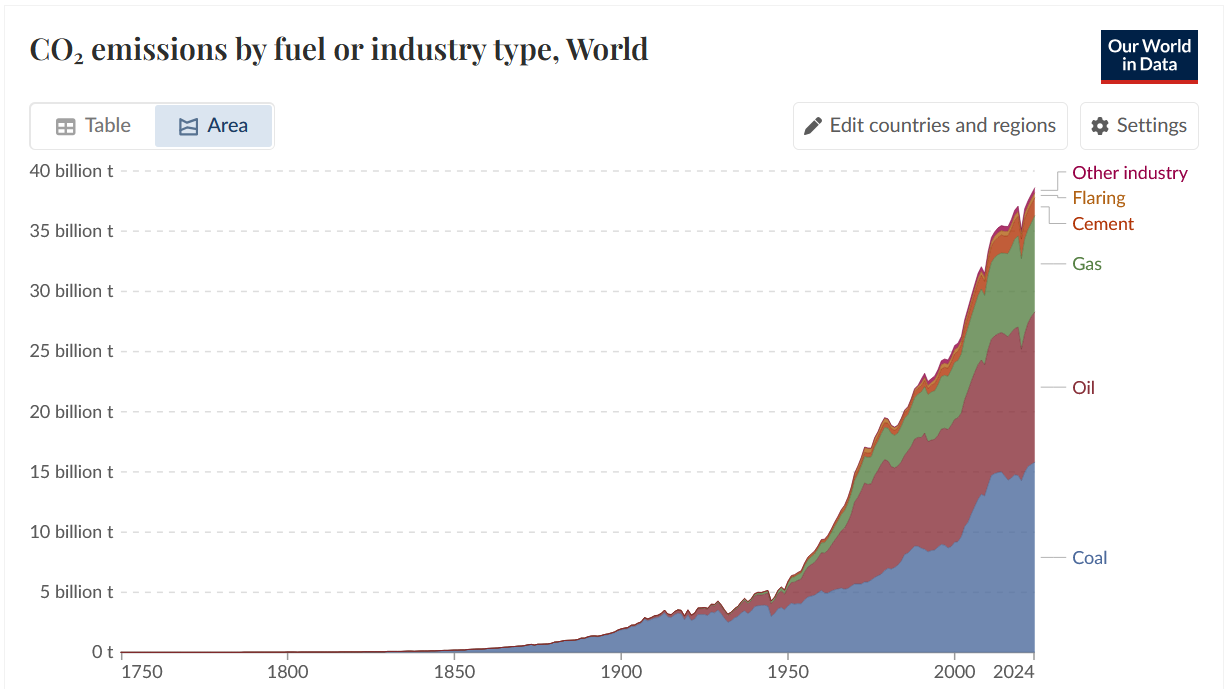
And the largest cost of all is the climate. Burning oil alone drives around 30 percent of the world’s energy related carbon dioxide emissions, slowly reshaping the seasons, storms, and seas for every living thing on it.
The plankton that built our modern world spent tens of millions of years (or longer) becoming oil. We are burning and discarding it in barely two centuries. We eat by it, dress in it, heal with it, and breathe its exhaust. Most of the modern necessities / luxuries of life today have been made possible by humanity’s brilliance of engineering naturally occurring substances to make our lives better. The toll of rampant overuse of resources without mitigation or safety measures is only compounding with time. Hope this post helps put things in perspective about how rooted plastic is in our daily lives. I am consciously trying to avoid it as much as I can. I hope you all do it too.
How was today’s post?
If you liked it, please hit the Like button below and share it with a friend. Hit the message button if you want to share feedback, and please Subscribe to AlterEarth if you haven’t already. Have a great day!
References
https://www.eia.gov/kids/energy-sources/oil/
https://oilfieldteam.com/en/a/learning/made-with-oil
https://ourworldindata.org/emissions-by-fuel
Tissot, B.P., and Welte, D.H. (1984). Petroleum Formation and Occurrence (2nd ed.). Springer, Berlin. DOI: 10.1007/978-3-642-87813-8
Vohra, K., Vodonos, A., Schwartz, J., Marais, E.A., Sulprizio, M.P., and Mickley, L.J. (2021). Global mortality from outdoor fine particle pollution generated by fossil fuel combustion. Environmental Research, 195, 110754. DOI: 10.1016/j.envres.2021.110754
Leslie, H.A., van Velzen, M.J.M., Brandsma, S.H., Vethaak, A.D., Garcia-Vallejo, J.J., and Lamoree, M.H. (2022). Discovery and quantification of plastic particle pollution in human blood. Environment International, 163, 107199. DOI: 10.1016/j.envint.2022.107199
Ragusa, A., Svelato, A., Santacroce, C., et al. (2021). Plasticenta: First evidence of microplastics in human placenta. Environment International, 146, 106274. DOI: 10.1016/j.envint.2020.106274
https://www.eia.gov/energyexplained/oil-and-petroleum-products/refining-crude-oil.php
https://www.cancer.org/cancer/risk-prevention/chemicals/benzene.html
Great information Kalyan!! I copied two figures